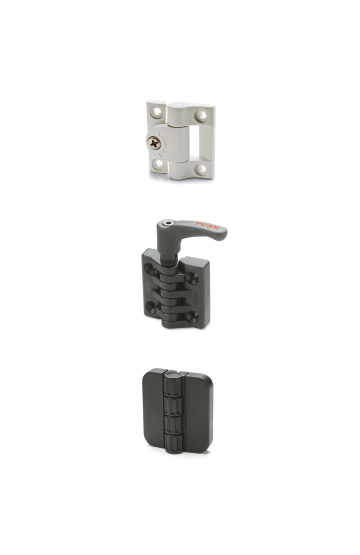
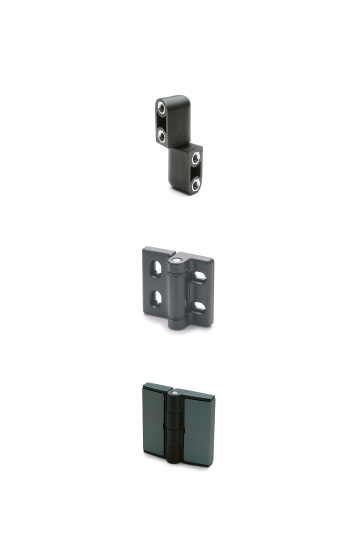
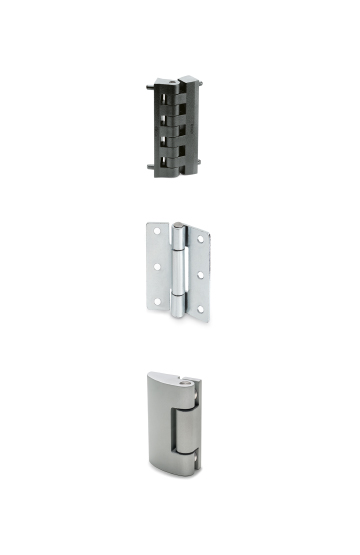
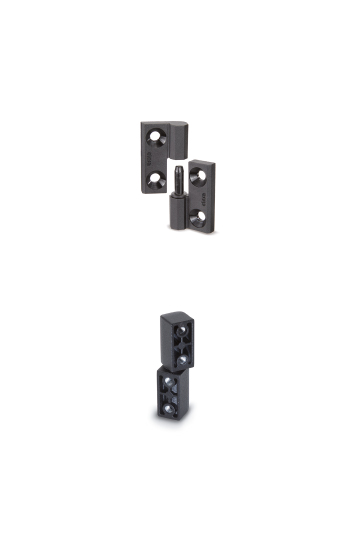
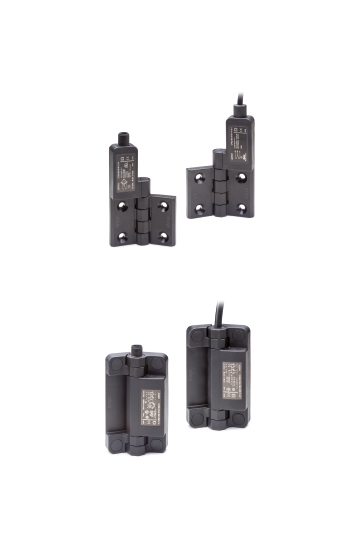
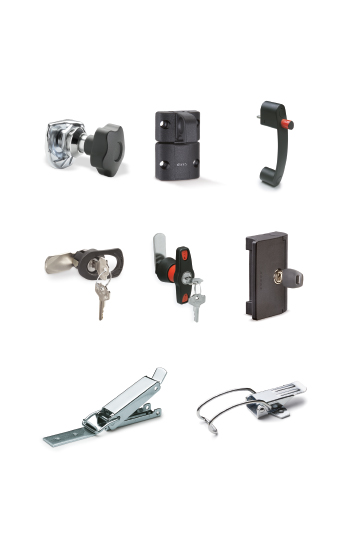
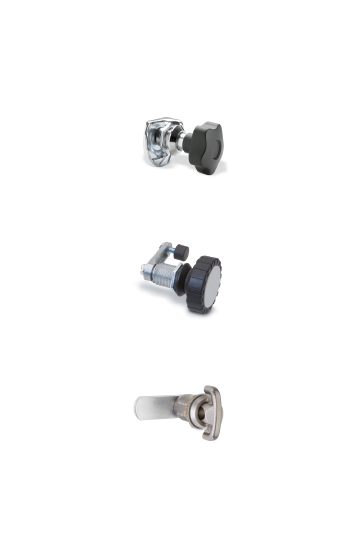
Access panels, machine guards, and enclosure doors in industrial environments require regular removal, for maintenance, inspection, fault diagnosis, and cleaning. Fixed hinges make this a fastener-dependent task. In tight installations, such as production lines where adjacent machinery limits the available swing arc, a panel on fixed hinges that cannot be fully opened cannot be easily removed without disassembling part of the frame. Across multiple panels and multiple maintenance windows, the cumulative effect on productive time is measurable.
Lift-off hinges eliminate the fastener dependency. The door or panel leaf separates from the frame leaf by a simple vertical lift, requires no tools, and re-engages by reversing the motion. This single mechanical difference has practical consequences across several distinct engineering scenarios.
The Elesa Lift-Off Hinge Range
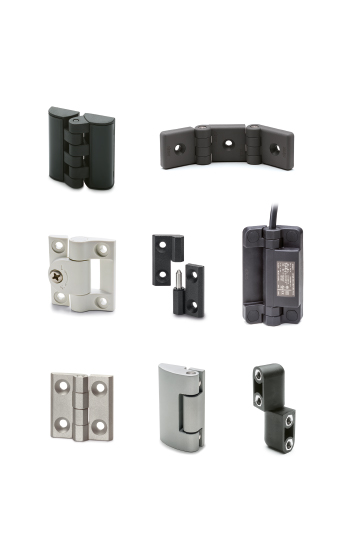
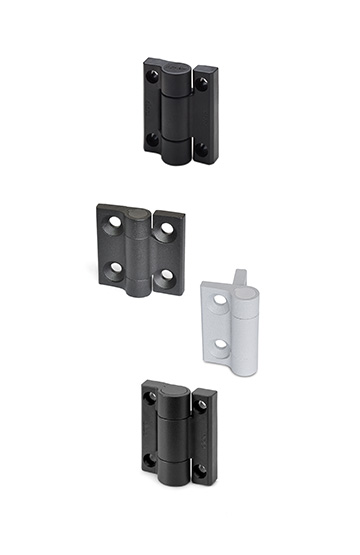
Elesa manufactures five product series in its lift-off hinge range, each suited to a different installation requirement. All body components across the range use glass-fibre reinforced polyamide (PA) technopolymer with a matte black finish. Pin interfaces use self-lubricating glass-fibre reinforced PA, removing the need for scheduled lubrication throughout the product's service life.
- Standard Lift-Off Hinge. Body material is glass-fibre reinforced PA SUPER-technopolymer. The pin is available left-fitted (CFMY-S) or right-fitted (CFMY-D) to suit the door hand. Maximum rotation is 270° (from −90° to +180°, measured from coplanar). Mounting uses pass-through countersunk screw holes. This is the general-purpose series for machine guards, enclosure doors, and access panels where tool-free panel removal is the primary requirement.
- Profile-Compatible Lift-Off Hinge. Functionally equivalent to the CFMY, but the hinge body is designed to locate directly into 40 mm aluminium extrusion profiles with 8–10 mm slot widths. Available in black or grey (RAL 7040). Pin is left (CFGY-S) or right (CFGY-D). Maximum rotation is also 270°. Intended for machine guards and safety enclosures built on modular aluminium framing systems, where drilling or secondary brackets would undermine the reconfigurability of the frame system.
- Offset Lift-Off Hinge. An Elesa-patented design. The hinge body incorporates an eccentric pin. Rotating the pin changes the effective pivot axis position, allowing post-installation door alignment correction without modifying the frame or door structure. Two CFO hinges used together with pins rotated in opposing directions- shift the door laterally relative to the frame. This addresses a common field-installation problem where as-built tolerances cause enclosure doors to misalign with frame seals or latch points after fitting.
- In-Line Lift-Off Hinge With Spring Return. Body material is glass-fibre reinforced PA technopolymer. The pin is AISI 303 stainless steel; the spring is stainless steel. The built-in spring system (Elesa patent) returns the door automatically on closing or opening, depending on spring winding direction and hinge orientation. Suffix S indicates left spring winding; suffix D indicates right spring winding. Four mounting variants accommodate different jamb-side and door-side fixing configurations: CFNR-B, CFNR-p, CFNR-B-p, and CFNR-p-B. An installation tool (MT-CFNR) is available to hold the hinge in the 90° preloaded position during assembly. Stainless construction is relevant in washdown environments where standard carbon steel hinges corrode under repeated high-pressure cleaning cycles.
- Lift-Off Hinge With Mechanical Lock. The CFMY-NL adds an axial locking mechanism to the standard lift-off geometry. When engaged, the two hinge bodies are locked together along the vertical axis, preventing separation regardless of loading on the panel. This is the only series in the range technically suitable for horizontal-axis (hatch-type) installations, where gravity does not retain the panel on the hinge, and an unlocked lift-off hinge presents an inadvertent separation hazard. Two locking variants are available: CFMY-NL-M uses a built-in key permanently attached to the hinge body; CFMY-NL-T requires a separate hexagonal key, which provides basic access restriction for controlled-access installations. Two coupling angles are offered — 0° for perimeter guarding and partition panels, 90° for conventional door-on-frame configurations. Maximum rotation is 195° (−15° to +180°). Locking components are POM (acetal resin) technopolymer.
Across the series, lift-off hinges are relevant wherever access panels must be removed and replaced during maintenance windows without fastener tools, and in modular extrusion-framed enclosures where standard slot-mount integration is required without secondary machining. The CFO series specifically addresses post-installation door alignment correction in electrical and control panel enclosures. The CFNR series suits hygiene-critical or access-controlled environments requiring automatic door return and corrosion-resistant construction. The CFMY-NL series is the appropriate choice for hatch and overhead access panels where inadvertent panel separation is a safety hazard and a mechanical lock on the lift axis is required.
Product Selection Reference
For tool-free panel removal on a standard door, the CFMY-S or CFMY-D is the appropriate starting point. Where the frame is built from aluminium extrusion profiles, the CFGY-S or CFGY-D mounts directly into standard slots without modification. If door misalignment needs correcting after installation, the CFO achieves this through its eccentric pin without touching the frame or fasteners. In washdown environments or where doors must close automatically, the CFNR is specified by fixing configuration (-B, -p, -B-p, or -p-B) and spring winding direction (S or D). For any hatch installation or horizontal-axis door where panel separation must be positively prevented, the CFMY-NL-M (built-in key) or CFMY-NL-T (separate hex key) is selected, with coupling angle specified as -0 or -90 depending on installation geometry.