

San - Antimicrobial
Sulje



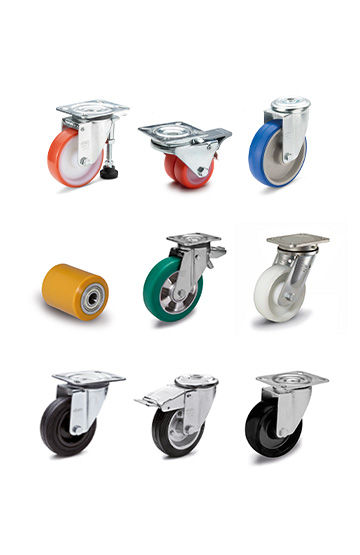
The wheel is a mechanical assembly in which sliding motion is replaced by rolling motion through rotation around an axis.
The wheel consists of the following components:
the tread, the covering, the wheel centre body, the bore and the rolling action.

The tread is the wheel’s outer surface, i.e. the part that comes in contact with the ground. It can be smooth or engraved with raised patterns to increase its grip on the ground.
The covering, or rolling strip, is the outer ring. It is made of different materials and characterises the wheel. The covering is fixed when joined with the wheel centre body as a single solid piece (using an adhesive or through a mechanical connection) or fitted when mechanically assembled on the wheel centre body.
The wheel centre body is the wheel part that connects the covering to the bore. It comes in various shapes and is made of different materials; it can be a single piece or two or more parts joined together.
The bore is the middle part of the wheel that houses the axle or the rolling actions that make rotation easier (ball bearings, roller bearings, plain bearings, etc.).
Depending on the construction methods and materials forming the covering, wheels can be divided into three families: rubber wheels, polyurethane wheels and monolithic (or hard tread) wheels.