

San - Antimicrobial
Close
May 11, 2026
Reading time: minutes
Vacuum suction cups are one of the most widely used gripping technologies in industrial automation. They handle everything from delicate food items and glass panels to heavy sheet metal and moulded plastic components, without the need for mechanical clamping. This guide explains how they work, the main types available, and how to choose the right cup for your application.
A vacuum suction cup grips by creating a partial vacuum between the cup and the workpiece surface. When the cup is pressed against the surface and air is evacuated, atmospheric pressure (approximately 1 bar) pushes the object outward against the cup, holding it firmly in place.
The holding force depends on two variables: the vacuum level applied (measured in bar) and the effective contact area of the cup. A larger cup at higher vacuum holds more. In practice, engineers calculate the theoretical holding force and then apply a safety factor, typically 1.5 to 2 times, to account for acceleration forces, surface variation, and vacuum decay over time.
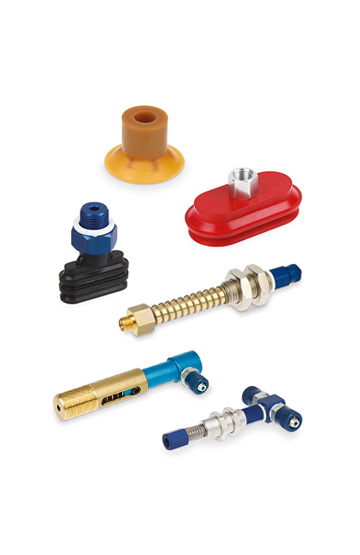
The system has three main components: the suction cup itself, a vacuum generator (either a venturi ejector or an electric pump), and the cup holder or fitting that mounts the cup to the gripper or robot arm.
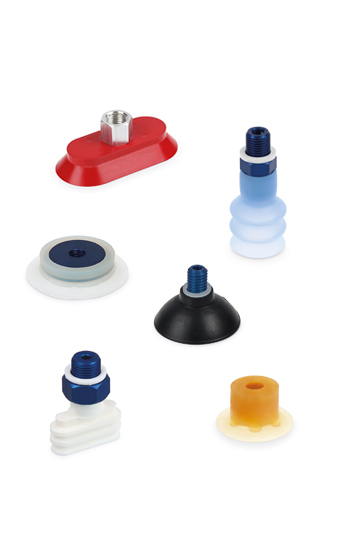
Cup selection starts with the shape and texture of the workpiece. The three principal profiles are flat, bellows, and oval.
Flat cups have a rigid or semi-rigid profile with minimal axial compression. They are the standard choice for smooth, flat workpieces where precise, repeatable positioning matters. Common applications include sheet metal handling, glass processing, printed circuit board assembly, and flat cardboard packaging. Because they do not compress under load, flat cups deliver accurate placement and fast cycle response, making them the preferred option in high-speed pick-and-place systems.
Bellows cups have one or more convolutions (concertina-like folds) built into the cup body. These folds allow the cup to compress and extend axially, compensating for height variation between workpieces or for surfaces that are not perfectly presented to the gripper. Single-fold bellows cups suit slightly curved or mildly uneven surfaces, such as automotive body panels or moulded plastic parts. Multi-fold versions provide greater height compensation and a softer approach, making them the right choice for delicate, fragile, or strongly curved workpieces such as fruit and vegetables, ceramics, and medical components.
Oval cups provide a larger contact footprint in one axis, making them well suited to long, narrow workpieces where a round cup would bridge an edge or fail to seal. They are widely used in woodworking, door panel handling, and flat-pack furniture manufacturing, where boards and profiles need to be picked reliably along their length.
The elastomer material determines chemical compatibility, temperature range, grip characteristics, and suitability for regulated environments such as food processing. The four most common materials are NBR, silicone, EPDM, and polyurethane.
NBR is the most widely used vacuum cup material in general industry. It offers good resistance to oils, greases, and hydraulic fluids, operates reliably between −20°C and +80°C, and is cost-effective across a wide range of applications. It is the standard choice for metalworking, general automation, and any environment where oil contamination on the workpiece surface is likely.
Silicone cups are specified wherever temperature extremes or food-contact compliance is required. They operate from −60°C to +180°C and are approved for direct food contact, making them the default choice in bakery, confectionery, and hot-forming applications. Silicone has lower abrasion resistance than NBR, so it is not suited to rough or highly abrasive surfaces.
EPDM offers strong resistance to weathering, ozone, UV radiation, and water-based chemicals. It is the right material for outdoor equipment, wash-down environments, and applications involving steam or aggressive cleaning agents. EPDM should not be used with mineral oils or petroleum-based fluids.
Polyurethane cups offer outstanding abrasion resistance, significantly better than NBR or silicone. They are the preferred choice for rough, abrasive, or textured surfaces including timber, stone, rough castings, and concrete panels. Where other materials would wear rapidly, polyurethane maintains its seal integrity over a much longer service life.
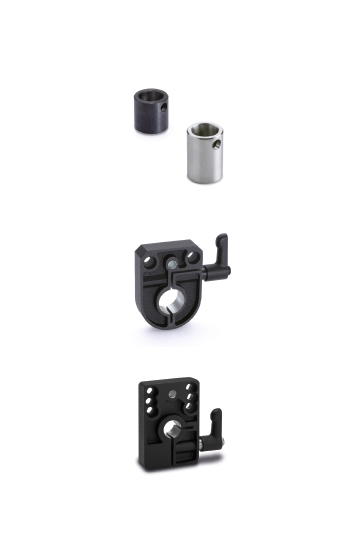
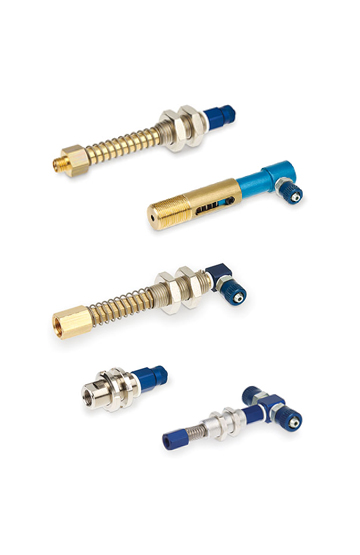
The cup holder connects the suction cup to the robot arm or gripper frame and plays a more important role than is often appreciated. A fixed holder works well when workpieces are presented in a tightly controlled, repeatable orientation, such as in precision electronics assembly. A spring-suspended holder allows the cup to tilt and compensate for angular misalignment, which is essential when workpieces vary in presentation angle, arrive on a vibrating conveyor, or are approached from a direction that is not perfectly perpendicular to the surface. Specifying a fixed holder where a spring-suspended one is needed is one of the most common causes of inconsistent grip and dropped workpieces.
Five questions determine the right specification.
Flat and smooth surfaces suit flat cups. Curved, contoured, or height-variable workpieces need bellows cups. Rough or abrasive surfaces call for polyurethane and, usually, a larger cup diameter to offset the lower sealing efficiency. Porous surfaces such as uncoated timber, foam, and unfinished cardboard lose vacuum quickly; specify a larger cup and ensure the vacuum generator has sufficient flow rate to compensate.
Calculate the holding force from the workpiece weight and any acceleration or deceleration forces in the system. Apply a safety factor of at least 1.5 for straightforward vertical lifting. Use 2.0 or higher for horizontal movement, inverted handling, or fast dynamic cycles. When using multiple cups, calculate the load per cup conservatively and do not assume the load distributes evenly across all cups at all times.
Temperature and chemical exposure narrow the material choice quickly. For food contact, silicone is the standard. For oily conditions, NBR. For outdoor or wash-down environments, EPDM. For abrasive surfaces, polyurethane. In pharmaceutical or food manufacturing, also consider whether metal-detectable cup materials are required, as these are available as a specialist option.
Faster cycles leave less time to build vacuum and confirm grip. Flat cups respond more quickly than bellows cups. At high speeds, pair the cup with a vacuum generator that has a fast response time and consider adding a vacuum sensor to verify that grip has been established before the cycle continues.
Food-contact applications should specify cups certified to EU Regulation 10/2011 or equivalent. Explosive atmosphere installations require ATEX-compliant components throughout the system. Pharmaceutical and food-processing lines often require metal-detectable or visually detectable materials to meet contamination control protocols.
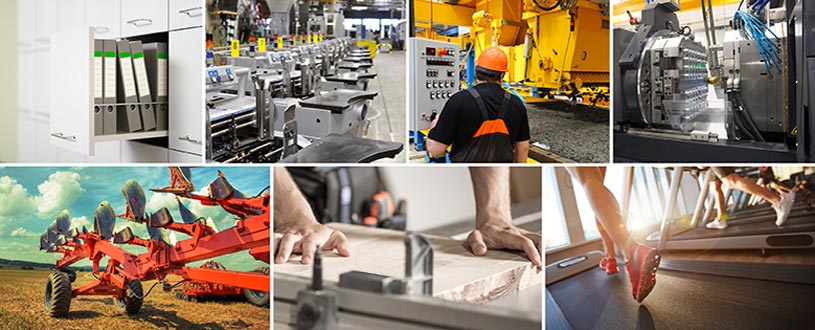
Vacuum suction cups are used across most sectors of modern manufacturing and processing. The following are among the most common:
Elesa's vacuum component range covers flat, bellows, and oval cup profiles across all four principal elastomers, together with a full selection of cup holders and fittings. All products are available with 3D CAD downloads direct from elesa.com, and the UK store offers reduced-rate shipping on online orders.