
SELF-SANITIZATION AGAINST BACTERIA AND FUNGI
Close

Corrosion resistant, ergonomic, compact shapes in choice materials with easy-clean finishes
Components for construction vehicles, equipment and machinery

Stainless steel
AISI 303
Plunger pin chemically nickel plated
Knob, Plastic (Polyamide PA)
black, matte
not removable
Magnet
Hard ferrite
Sensor / Sensor clip
Plastic (Polyamide PA), black, matte
Cable (Outer sheath)
Polyurethan PUR, black
Locking nut ISO 8675
Stainless Steel AISI 304
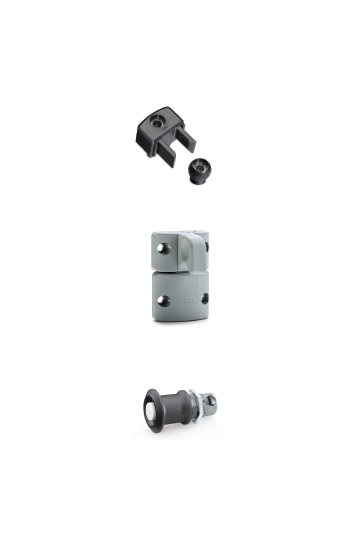
GN 817.6 stainless steel plungers are fitted with a sensor which allows electronic monitoring of the pin position. For this purpose, a magnet is integrated into the plunger pin that switches the sensor upon engaging after approx. 2/3 of the locking distance l1.
To prevent malfunctions, avoid the presence of magnetic fields acting on the plunger. GN 817.6 stainless steel plungers are fitted with a sensor, sensor clip, Allen® key and locking nut.
Degree of protection IP in accordance with EN 60529 table.
| Electrical properties of the sensor | ||
|---|---|---|
| Output function | Normally open (NO) |  |
| Switching transistor | PNP | |
| Supply voltage | 10 - 30 V DC | |
| Continuous current la | ≤ 100 mA | |
| Type of connection (S): | 3-pole M8x1 circular connector with locking nut and 0.5 m long PUR cable |  |
| Degree of environmental protection | IP 67 | |
| Switching frequency | 1,000 Hz | |
| Power consumption | ≤ 8 mA | |
| Voltage drop | ≤ 2.5 V | |
| Protection class | III | |
| Response sensitivity | 2.8 mT | |
| Temperature range | -25 °C ... +75 °C | |
| Shock andvibration resistance | 30 g, 11 ms / 10 ... 55 Hz, 1 mm | |
| Reverse polarity protection | Yes | |
| Short-circuit protection | Yes | |
| Activation impulse suppression | Yes | |
| Approvals, conformities CE declaration |  | |
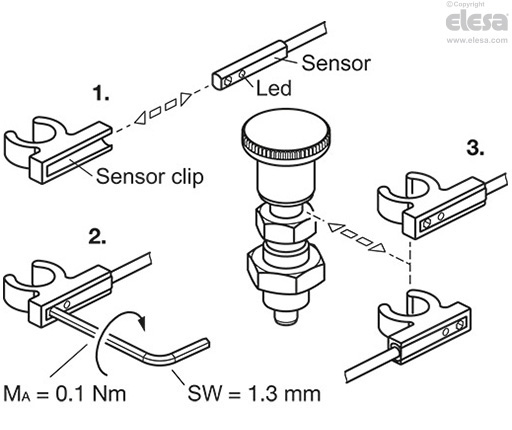
1. Insert the sensor into the sensor clip from the side.
2. Tighten the hexagon socket screw of the sensor.
3. Clip the sensor clip into the ring groove of the indexing plunger in any orientation and then adjust the direction by turning, if necessary.